Instrument Landing System (ILS)
Instrument Landing System (ILS)
Article Information
Category:

Content source:

Content control:

Last modified:
16.Jul.2024
Article UID:
Cite This Page
SKYbrary Aviation Safety. (July 16, 2024). Instrument Landing System (ILS).
Retrieved September 2, 2026
from https://skybrary.aero/articles/instrument-landing-system-ils
UID: 30352
Copied!
COPY
Definition
Instrument Landing System (ILS) is defined as a precision runway approach aid based on two radio beams which together provide pilots with both vertical and horizontal guidance during an approach to land.
Description
An Instrument Landing System is a precision runway approach aid employing two radio beams to provide pilots with vertical and horizontal guidance during the landing approach. The localiser (LOC) provides azimuth guidance, while the glideslope (GS) defines the correct vertical descent profile. Marker beacons and high intensity runways lights may also be provided as aids to the use of an ILS, although the former are more likely nowadays to have been replaced by a DME integral to the ILS or one otherwise located on the aerodrome, for example with a VOR.

Figure 1. Localiser
The ILS LOC aerials are normally located at the end of the runway; they transmit two narrow intersecting beams, one slightly to the right of the runway centreline, the other slightly to the left which, where they intersect, define the "on LOC" indication (see Figure 1). Airborne equipment provides information to the pilot showing the aircraft’s displacement from the runway centreline.
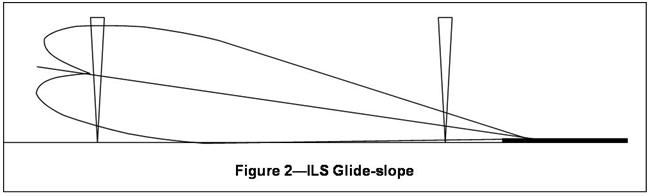
Figure 2. Glide-slope
The ILS GS aerials are normally located on the aerodrome; they transmit two narrow intersecting beams, one slightly below the required vertical profile and the other slightly above it which, where they intersect, define the "on GS" indication (see Figure 2). Aircraft equipment indicates the displacement of the aircraft above or below the GS. The GS aerials are usually located so that the glide-slope provides a runway threshold crossing height of about 50 ft. The usual GS angle is 3 degrees but exceptions may occur, usually to meet particular approach constraints such as terrain or noise abatement.
If marker beacons are provided, they will be located on the ILS approach track at notified distances from touch-down (see Figure 2). Typically, the first marker beacon (the Outer Marker) would be located about 5 NM from touch-down while the second marker beacon (the Middle Marker) would be located about 1 NM from touch-down.
An approach may not normally be continued unless the runway visual range (RVR) is above the specified minimum. When an approach is flown, the pilot follows the ILS guidance until the decision height (DH) is reached. At the DH, the approach may only be continued if the specified visual reference is available, otherwise, a go-around must be flown.
Special categories of ILS approach are defined which allow suitably qualified pilots flying suitably equipped aircraft to suitably equipped runways using appropriately qualified ILS systems to continue an ILS approach without acquiring visual reference to a lower DH than the Category I standard of 200 feet above runway threshold elevation (arte) and do so when a lower reported RVR than the 550 metres usually associated with Category I:
- Category II permits a DH of not lower than 100 ft and an RVR not less than 300 m;
- Category IIIA permits a DH below 100 ft and an RVR not below 200 m;
- Category IIIB permits a DH below 50 ft and an RVR not less than 50 m;
- Category IIIC is a full auto-land with roll out guidance along the runway centreline and no DH or RVR limitations apply. This Category is not currently available routinely primarily because of problems which arise with ground manoeuvring after landing.
The special conditions which apply for Category II and III ILS operation cover aircraft equipment; pilot training and the airfield installations. In the latter case, both function, reliability and operating procedures are involved. An example of the latter is the designation of runway holding points displaced further back from the runway so as to ensure that aircraft on the ground do not interfere with signal propagation. Reliability requirements for Category II and III ILS include a secondary electrical power supply which should be fully independent of the primary one.
The transmission of ILS signals is continuously monitored for signal integrity and an installation is automatically switched off leading to the immediate display of inoperative flags on aircraft ILS displays selected to the corresponding frequency if any anomaly is detected. The reliability of this monitoring function is increased where approaches to minima lower than Category I are permitted and all ILS systems are subject to regular calibration flights to check that signals are being correctly transmitted. These checks only validate that the ILS is performing as intended and do not routinely investigate the indications which aircraft would receive if flown beyond signal validity.
It is very important to note that only a full ILS with LOC and GS signals is a precision approach. If only the LOC is transmitting then it can only support a Non-Precision Approach with increased minima, albeit this should be a lower minima than an equivalent VOR would enable.
Validity of ILS Guidance
An ILS is only valid if used within strict boundaries either side of the transmitted LOC and GS beams as documented on the corresponding AIPs Instrument Approach Procedure (IAP). From a pilot perspective, these limits are defined as Full Scale Deflection (FSD) of the deviation indication on the ILS displays in the flight deck, since once the deviation in respect of either the LOC or GS reaches FSD, it becomes impossible to know the extent of the deviation.
Because of this, pilots navigating their aircraft onto an ILS, whether from below the GS or above, have always been expected, when acquiring an ILS GS, to cross-check their range from touchdown against their indicated altitude/height and confirm that their aircraft is on the promulgated IAP GS.
False Glideslope Acquisition
An issue with ILS is that secondary glide slopes appear above the primary one. This is caused by the radiation pattern of the antenna and the ground reflection of some of the transmitted energy. The false glide slopes appear at odd multiples of the true glide-slope angle (e.g. if the main GS is at 3°, then the secondary slopes will be at 9°, 15° and 21°). Capturing a false GS can lead to unexpected aircraft behavior, e.g. AP disconnect, unexpected engagement of GS acquisition mode, excessive pitch down or climb. This may ultimately result in an unstabilised approach and the need for a go around. The unexpected behaviour is often due to a combination of factors - the existance of false GS, improper aircraft automation settings (e.g. AP) and loss of crew situational awareness (e.g. being unaware that the aircraft level does not correspond to the distance to touchdown). An altitude vs distance check (to determine that the aircraft is below the GS upper boundary) and strict adherence to SOPs can mitigate the risk.
Examples of occurrences that happened because of false GS acquisition include:
- A318, vicinity Toulon-Hyères France, 2019
- B738, vicinity Eindhoven Netherlands, 2013
- A343, vicinity Paris CDG France, 2012
More information on this subject, including technical details and crew recommended actions can be found in a dedicated article by Airbus.
Categories
What Links Here (343)
- Weather
- Runway Incursion and Airport Design
- Air Traffic Controller (ATC) Expectation Bias
- Automatic Direction Finding (ADF)
- GBAS Landing System (GLS)
- Instrument Approach Procedure (IAP)
- Localiser (LOC) and Localiser Type Directional Aid (LDA) Approaches
- Non-Directional Beacon
- Precision Approach
- Precision Approach Radar (PAR)
- Runway Visual Range (RVR)
- VHF Omnidirectional Radio Range (VOR)
- Visual Approach
- World Geodetic System 1984 (WGS84)
- D328, vicinity Manchester UK, 2006
- MD11, vicinity East Midlands UK, 2005
- B744, en-route, South China Sea, 2008
- B752, vicinity Gardermoen Oslo Norway, 2002
- SH36, vicinity East Midlands UK, 1986
- A320, vicinity Perpignan France, 2008
- B752, vicinity Cali Colombia, 1995
- JS31, Fort St. John BC Canada, 2007
- E170, Cleveland OH USA, 2007
- B752, vicinity London Gatwick UK, 2008
- F50 / T6, vicinity Maastricht Netherlands, 2007
- A306, vicinity Nagoya Japan, 1994
- A333, vicinity Wom Guam Airport, Guam, 2002
- B743, vicinity Won Guam Airport, Guam, 1997
- MD83, vicinity Dublin Airport, Ireland, 2007
- B742, en-route, south southeast of Jakarta Indonesia, 1982
- B733, vicinity Bournemouth UK, 2007
- B735, vicinity Perm Russian Federation, 2008
- A320, vicinity Sochi Russia, 2006
- B734, vicinity East Midlands UK, 1989
- B738, vicinity Amsterdam Netherlands, 2009
- A320, vicinity Melbourne Australia, 2007
- A320, vicinity Glasgow UK, 2008
- DH8D, vicinity Edinburgh UK, 2008
- E135, George South Africa, 2009
- B734, Yogyakarta Indonesia, 2007
- MD11, Hong Kong China, 1999
- B752, Newark NJ USA, 2006
- CRJ2, Providence RI USA, 2007
- E145, Hannover Germany, 2005
- E170, Frankfurt Germany, 2005
- MD83, vicinity Paris Orly France, 1997
- A320 / B738, vicinity Launceston Australia, 2008
- B712, Darwin Australia, 2008
- DH8C, vicinity Sydney Australia, 2008
- AT43, vicinity Pristina Kosovo, 1999
- A321, Hakodate Japan, 2002
- CRJ2, Traverse City MI USA, 2007
- F28, Saint John NB Canada, 2002
- E135, Norwich UK, 2003
- E145, Nuremberg Germany, 2005
- B744, en-route NNW of Bangkok Thailand, 2008
- B744, vicinity Dubai UAE, 2010
- S61, vicinity Bødo Norway, 2008
- A320, Varadero Cuba, 2010
- B738, Hobart Australia, 2010
- B738, Mangalore India, 2010
- DH8D, Bournemouth UK, 2010
- A346, Quito Ecuador, 2007
- B752, Chicago O’Hare IL USA, 2008
- CRJ2, Vigo Spain, 2010
- B733, vicinity Chambery France, 2010
- AT43, Lubbock TX USA, 2009
- C501, Birmingham UK, 2010
- A310, Vienna Austria, 2000
- B752, en-route, vicinity Chancay Peru, 1996
- TBM8, Birmingham UK, 2011
- CRJ9 / Vehicles, Whitehorse YK Canada, 2009
- E145, Dayton OH USA, 2011
- MD81, Grenoble France, 2010
- A321, vicinity Singapore, 2010
- GLF4, Bedford MA USA, 2014
- GLEX/F2TH, vicinity Ibiza Spain, 2012
- A343 / GLID, en-route, north of Waldshut-Tiengen southwest Germany, 2012
- AT75, vicinity Magong Taiwan, 2014
- BE20, Nadi Fiji, 2010
- SB20, vicinity Sumburgh, UK 2014
- GLEX, Prestwick UK, 2014
- E55P, St Gallen-Altenrhein Switzerland, 2012
- Vehicle / B712, Perth Western Australia, 2014
- SF34, vicinity Newcastle New South Wales Australia, 2012
- A319 / B735, vicinity Prague Czech Republic, 2012
- IL76, St John's Newfoundland Canada, 2012
- A310, Ponta Delgada Azores Portugal, 2013
- B733, Yogyakarta Indonesia, 2011
- B735, Jos Nigeria, 2010
- CRJ2 / A320, vicinity Port Elizabeth South Africa, 2014
- AT75, vicinity Cork Ireland, 2014
- A321, Incheon South Korea, 2013
- C56X, Port Harcourt Nigeria, 2013
- B738, en-route, south south west of Brisbane Australia, 2013
- B190, vicinity Bebi south eastern Nigeria, 2008
- A332, vicinity Melbourne Australia, 2013
- A320, vicinity Lyons Saint-Exupéry France, 2012
- A321, vicinity Islamabad Pakistan, 2010
- B752, vicinity Keflavik Iceland, 2013
- B732, vicinity Islamabad Pakistan, 2012
- B737, New York La Guardia USA, 2013
- A332, Jakarta Indonesia, 2013
- C500, vicinity Santiago Spain, 2012
- B733 / DH8D, Fort McMurray Canada, 2014
- A320, vicinity Abu Dhabi UAE, 2012
- B738, Mangalore India, 2012
- B738, vicinity Eindhoven Netherlands, 2013
- A320 / GLID, vicinity Memmingen Germany, 2015
- SW4, Sanikiluaq Nunavut Canada, 2012
- CRJ9, San Sebastian Spain, 2013
- E190, Amsterdam Netherlands, 2014
- A320 / CRJ2, Port Elizabeth South Africa, 2014
- B738, vicinity Christchurch New Zealand, 2011
- B735, vicinity Kazan Russia, 2013
- MD88, New York La Guardia USA, 2015
- B738 / AS25, en-route, near Frankfurt Hahn Germany, 2013
- A319, vicinity Zurich Switzerland, 2014
- B738, vicinity Porto Portugal, 2015
- B739, Yogyakarta Indonesia, 2015
- B733, Tabing Padang Indonesia, 2012
- B744, vicinity Bishkek Kyrgyzstan, 2017
- A319, Montego Bay Jamaica, 2014
- B722 / BE10, Atlanta GA USA, 1990
- B738, Delhi India, 2014
- A320, Jaipur India, 2014
- SW4, en-route, near La Alianza Puerto Rico, 2013
- B738, Rostov-on-Don Russia, 2016
- B738, vicinity Trivandrum India, 2015
- B736, Montréal QC Canada, 2015
- A333, Montréal QC Canada, 2014
- A320, Halifax NS Canada, 2015
- MD83, vicinity Lagos Nigeria, 2012
- ATP, Vilhelmina Sweden, 2016
- F28, Gällivare Sweden, 2016
- A310, vicinity Moroni Comoros, 2009
- B738, Mildura VIC Australia, 2013
- B737, Mildura VIC Australia, 2013
- A320 / B789 / A343, San Francisco CA USA, 2017
- AT75 / B739, Medan Indonesia, 2017
- CRJX, Madrid Spain, 2015
- A319, Mumbai India, 2013
- A306, Yerevan Armenia, 2015
- B737, New York La Guardia USA, 2016
- B734, Lahore Pakistan, 2015
- B738, Katowice Poland, 2007
- A321, Fuerteventura Spain, 2016
- A319, Santiago de Compostela Spain, 2016
- GLF5, vicinity Hong Kong China, 2015
- L410, Isle of Man, 2017
- A320, vicinity Tokyo Haneda Japan, 2016
- A320, Toronto ON Canada, 2017
- B734, Timbuktu Mali, 2017
- A320 / AT76, Yangon Myanmar, 2017
- B734, Kabul Afghanistan, 2016
- B748, Amsterdam Netherlands, 2017
- DC10, Fort Lauderdale FL USA, 2017
- DC10, Macau SAR China, 2005
- B738, Rome Ciampino Italy, 2008
- A319 / AS32, vicinity Marseille France, 2016
- A320, vicinity Perth Australia, 2015
- A320 / B738, vicinity Delhi India, 2016
- CRJ9, Turku Finland, 2017
- B773, Munich Germany, 2011
- A320, vicinity Delhi India, 2017
- A321, vicinity Deauville France, 2013
- SB20, vicinity Billund Denmark, 2015
- B738 / A320, Edinburgh UK, 2018
- B738, Darwin Australia, 2016
- SU95, Moscow Sheremetyevo Russia, 2019
- B772, Dhaka Bangladesh, 2018
- F50 / P28T, vicinity Friedrichshafen Germany, 2016
- A319, Munich Germany, 2017
- AN26, vicinity Cox’s Bazar Bangladesh, 2016
- B789 / B773, Delhi India, 2017
- A343, Bogota Colombia, 2017
- B734, en-route, eastern England UK, 2018
- E50P, Berlin Schönefeld Germany, 2013
- AT45, vicinity Esbjerg Denmark, 2016
- B738, Manila Philippines, 2018
- AT76, Lisbon Portugal, 2016
- A319, vicinity Glasgow UK, 2018
- B752, Alicante Spain, 2017
- A320, Macau SAR China, 2018 (1)
- E195, vicinity Salzburg Austria, 2017
- C25A, Bern Switzerland, 2018
- F2TH / GLID, vicinity St Gallen-Altenrhein Switzerland, 2017
- A320 / SF34, vicinity London Stansted UK, 2019
- A310 / C421, en-route, northeast of Montréal Canada, 2018
- AT76, Fez Morocco, 2018
- AT75, en-route, near Almansa Spain, 2017
- SF34, Savonlinna Finland, 2019
- A320, vicinity Karachi Pakistan, 2020
- B738, Sochi Russia, 2018
- DH8D, Yangon Myanmar, 2019
- A320 (2) / CRJX (2) / B738 (3) / A332, vicinity Madrid Barajas Spain, 2018
- DH8D, vicinity Exeter UK, 2010
- A306, East Midlands UK, 2011
- B722, Moncton Canada, 2010
- AT72, en-route, southern Scotland UK, 2011
- CRJ2/ATP, Stockholm Sweden, 2011
- E145, Stuttgart Germany, 2009
- B738, en-route, east of Asahikawa Japan, 2010
- MD82, Phuket Thailand, 2007
- F100, Southampton UK, 1998
- B744 / Vehicle, Luxembourg Airport, Luxembourg 2010
- CRJ7, Kanpur India, 2011
- A320, Cochin India, 2011
- RJ1H, vicinity Zurich Switzerland, 2011
- D328, Norwich UK, 2012
- CRJ2, Menorca Spain, 2011
- B734, Palembang Indonesia, 2008
- D328, Mannheim Germany, 2008
- A319, Luton UK, 2012
- B738, vicinity Memmingen Germany, 2012
- A320/B734, vicinity London Gatwick UK, 2012
- B722, Lagos Nigeria, 2006
- A319, London Heathrow UK, 2013
- A310, Khartoum Sudan, 2008
- A319/A332, vicinity Barcelona Spain, 2012
- A320, vicinity Oslo Norway, 2008
- FA20, Durham Tees Valley UK, 2012
- SF34/AT72, Helsinki Finland, 2011
- BE20, vicinity Glasgow UK, 2012
- A332/B738, vicinity Amsterdam Netherlands, 2012
- AT43, vicinity Glasgow, UK 2012
- A343, vicinity Paris CDG France, 2012
- B739, Pekanbaru Indonesia, 2011
- A333, vicinity Orlando FL USA, 2013
- SF34, vicinity Mariehamn Finland, 2012
- C550, vicinity Cagliari Sardinia Italy, 2004
- CRJ2, Barcelona Spain, 2011
- B738, vicinity Kittilä, Finland 2012
- A320 / C56X, vicinity Geneva Switzerland, 2011
- SW4, Cork Ireland, 2011
- E145, Ljubljana Slovenia, 2010
- B738/B738, vicinity Oslo Norway, 2012
- B732, vicinity Resolute Bay Canada, 2011
- A333, en-route, near Bournemouth UK, 2012
- B742, Düsseldorf Germany, 2005
- B772, San Francisco CA USA, 2013
- A332, Caracas Venezuela, 2013
- A319, vicinity Tunis Tunisia, 2012
- B738, Kingston Jamaica, 2009
- B738, Perth Australia, 2008
- A342, Perth Australia, 2005
- A30B, Bratislava Slovakia, 2012
- A318/B738, Nantes France, 2010
- A319, Casablanca Morocco, 2011
- CRJ7, Lorient France, 2012
- H25B, vicinity Owatonna MN USA, 2008
- CFIT Precursors and Defences
- Controlled Flight Into Terrain (CFIT)
- Lessening the Effects of Visual Illusions
- Use of Radio Altimeter
- Visual References
- Taxiway Lighting
- Taxiway Surface Markings and Signs
- Top 10 Stabilised Approach Considerations for Air Traffic Controllers
- Runway Visual Perspective
- Flying a Visual Approach
- Runway Lighting
- Runway Identification
- Cross Wind Landings
- Descent below Glide-Path
- Runway Incursion, Taxi to Holding Position
- Pilot Handling Skills
- Parallel Runway Operation
- Approach and Landing Risks
- Terrain Avoidance and Warning System (TAWS)
- Low-Visibility Procedures (LVP)
- Runway Overrun After Unstabilised Approach (OGHFA SE)
- Simultaneous Approaches to Parallel Runways
- Active Ground Lighting Control
- Autoland
- Automated Cockpit Guidelines (OGHFA BN)
- Autopilot
- Distance Measuring Equipment (DME)
- ETOPS Diversion at Night (OGHFA SE)
- Flight Director
- Flight Preparation and Conducting Effective Briefings (OGHFA BN)
- Food Poisoning (OGHFA SE)
- Fuel Starvation, Stress, Fatigue and Nonstandard Phraseology (OGHFA SE)
- Head Up Display (HUD)
- In-flight Pilot Incapacitation (OGHFA SE)
- Landing At Wrong Airport (OGHFA SE)
- Landing Gear Failure (OGHFA SE)
- Non-stabilized Approach After ATC-Requested Runway Change (OGHFA SE)
- Preventing Runway Incursions at Small Aerodromes
- Progressive Taxi Instructions
- Transition to Visual Flight at Night (OGHFA SE)
- Trust
- Wind Shear Encounter During Go-Around (OGHFA SE)
- Unstabilised Approach: Late Runway or Approach Type Change
- Unstabilised Approach: Vectoring Resulting in Intercepting the Glidepath from Above
- Descend, Approach and Landing
- SE008: Precision-Like Approaches - Landing Systems (ILS, MLS, GLS)
- SE116: Precision-Like Approach (R-D)
- Localiser Performance with Vertical Guidance (LPV)
- Stabilised Approach
- Flight Crew Workload in Preparation for the Execution of an Approach
- Runway Holding Position
- A321, Charlotte NC USA, 2015
- B738 / DV20, vicinity Reus Spain, 2019
- A321, vicinity London Gatwick, UK 2020
- IL76, Yerevan Armenia, 2019
- A320, Raipur India, 2016
- A388, vicinity Moscow Domodedovo Russia, 2017
- A320, vicinity Jaipur India, 2016
- B737, en-route, west southwest of Pensacola FL USA, 2016
- MD82, Tarbes France, 2018
- B773, Hong Kong China, 2017
- E550, Paris Le Bourget France, 2017
- B735, vicinity Madrid Barajas Spain, 2019
- A320, Calicut India, 2019
- A320, Sylt Germany, 2017
- A333, Medan Indonesia, 2020
- A320, Surat India, 2017
- GLF4, Abuja Nigeria, 2018
- B738, vicinity Bergerac France, 2015
- GLEX, Liverpool UK, 2019
- B742, Sokoto Nigeria, 2013
- C56X, Aarhus Denmark, 2019
- A320, en-route, north of Marseilles France, 2017
- AT76, vicinity Dublin Ireland, 2016
- B738, vicinity Lanzarote Spain, 2019
- ATP, Birmingham UK, 2020
- DH8C, Stephenville NL Canada, 2018
- B712 / CRJ7, vicinity Strasbourg France, 2019
- AN26, vicinity Birmingham UK, 2020
- S92, manoeuvring, near Shipston-on-Stour UK, 2019
- B738, Halifax Canada, 2020
- B744, Halifax NS Canada, 2018
- GLEX, Biggin Hill UK, 2020
- A333, Port Harcourt Nigeria, 2019
- A359, vicinity Paris Orly France, 2020
- A320, vicinity Muscat Oman, 2019
- The Tower Controller
- Shallow fog: Guidance for flight crews
- B738, Calicut (Kozhikode) India, 2020
- AT75, Rome Fiumicino Italy, 2013
- B738, Pristina Kosovo, 2016
- B78X, vicinity Abu Dhabi UAE, 2020