Non-Precision Approach
Non-Precision Approach
Article Information
Category:

Content source:

Content control:

Last modified:
24.Jun.2022
Article UID:
Cite This Page
SKYbrary Aviation Safety. (June 24, 2022). Non-Precision Approach.
Retrieved September 2, 2026
from https://skybrary.aero/articles/non-precision-approach
UID: 1505
Copied!
COPY
Description
A non-precision approach is an instrument approach and landing which utilises lateral guidance but does not utilise vertical guidance. (ICAO Annex 6)
Non-precision approaches which are pilot-interpreted make use of ground beacons and aircraft equipment such as VHF Omnidirectional Radio Range (VOR), Non-Directional Beacon and the LLZ element of an ILS system, often in combination with Distance Measuring Equipment (DME) for range. Lateral guidance is provided by a display of either bearing to/from a radio beacon on the approach track or at the airfield or, in the case of an LLZ only approach, by display of the relative position of the LLZ track on the aircraft ILS instruments and vertical guidance is based on the range from the airfield as indicated by a DME at the airfield or on track or by timing based upon passage overhead radio beacons on the track described by the designated procedure.
Non-precision approaches are often conducted with less use of automated systems than precision approaches. However, on many modern aircraft, automatic systems may be left engaged until reaching the Minimum Descent Altitude/Height, or beyond.
For pilots of older aircraft, in which use of automated systems to assist in flying the approach is limited, a high degree of piloting skill is required to fly such approaches accurately and the frequent practice which many pilots need to achieve this can be difficult to come by if precision approaches are the normal method used.
A high proportion of Controlled Flight Into Terrain (CFIT) accidents have been shown to occur during non-precision approaches. This is in part a result of loss of situational awareness, e.g. resulting in descent before the initial approach fix; and in part a consequence of the lack of precise vertical guidance, which may involve leveling off at intermediate points between the initial approach fix and MDA/H (a step-down approach).
The Continuous Descent Final Approach (CDFA) technique has been promoted in order to mitigate the risks inherent in the standard step-down approach. This procedure may be further simplified in use by the vertical navigation (VNAV) feature of Flight Management System.
An example of a non-precision approach procedure is illustrated below.
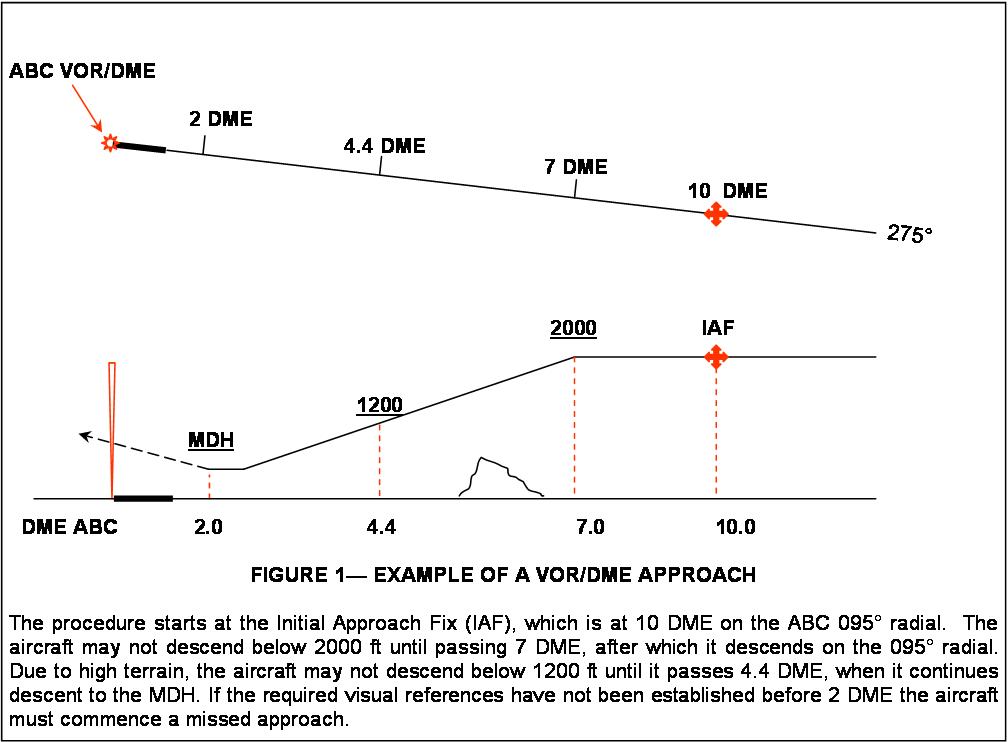
Other instrument approaches which utilise lateral and vertical guidance but do not meet the requirements established for precision approach and landing operations are also classified as non-precision approaches. Examples are a Surveillance Radar Approach (SRA) or a VDF approach.
See also Aerodrome Operating Minima (AOM).
Further Reading
- Air Pilots - Commercial Air Transport SAFETY BRIEFING NOTE 05: Non-Precision Approach using Ground Aids; November 2021.
- ICAO Annex 6;
Flight Safety Foundation
The Flight Safety Foundation ALAR Toolkit provides useful training information and guides to best practice. Copies of the FSF ALAR Toolkit may be ordered from the Flight Safety Foundation ALAR website http://www.flightsafety.org/current-safety-initiatives/approach-and-landing-accident-reduction-alar
Categories
What Links Here (89)
- Aerodrome Operating Minima (AOM)
- Instrument Approach Procedure (IAP)
- Localiser (LOC) and Localiser Type Directional Aid (LDA) Approaches
- Minimum Descent Altitude/Height (MDA/MDH)
- Non-Directional Beacon
- Operations Manual (OM)
- Runway Visual Range (RVR)
- Side-step Manoeuvre
- VHF Omnidirectional Radio Range (VOR)
- FA20, vicinity Narsarsuaq Greenland, 2001
- A320, vicinity Addis Ababa Ethiopia, 2003
- T154, vicinity Svalbard Norway, 1996
- SW4, vicinity Lockhart River Queensland Australia, 2005
- JS31, Skien Norway, 2001
- A320, Khartoum Sudan, 2005
- A333, vicinity Wom Guam Airport, Guam, 2002
- B743, vicinity Won Guam Airport, Guam, 1997
- B739, Akita Japan, 2007
- AN26, Kassel Germany, 2007
- T154, vicinity Smolensk Russian Federation, 2010
- AT75, vicinity Magong Taiwan, 2014
- A306, vicinity Birmingham AL USA, 2013
- AT72, vicinity Pakse Laos, 2013
- AT76, vicinity Moranbah Queensland Australia, 2013
- A333, Kathmandu Nepal, 2015
- SW4, Sanikiluaq Nunavut Canada, 2012
- A320, vicinity Naha Okinawa Japan, 2014
- B738, vicinity Porto Portugal, 2015
- H25B, vicinity Akron OH USA, 2015
- A319, Montego Bay Jamaica, 2014
- SW4, vicinity Red Lake ON Canada, 2013
- B738, vicinity Trivandrum India, 2015
- A320, Halifax NS Canada, 2015
- DH8A, Saulte Ste. Marie ON Canada, 2015
- B738, Mildura VIC Australia, 2013
- B737, Mildura VIC Australia, 2013
- DH8D, Hubli India, 2015
- A306, Yerevan Armenia, 2015
- B734, Lahore Pakistan, 2015
- DH8D, Kathmandu Nepal, 2018
- B733, vicinity Kosrae Micronesia, 2015
- JS41, Rhodes Greece, 2015
- B738, Sint Maarten Eastern Caribbean, 2017
- CRJ9, Turku Finland, 2017
- A320, Brasilia Brazil, 2015
- A319, Rio de Janeiro Galeão Brazil, 2017
- SB20, vicinity Billund Denmark, 2015
- WW24, vicinity Norfolk Island South Pacific, 2009
- B738, vicinity Denpasar Bali Indonesia, 2013
- AS3B, vicinity Sumburgh Airport Shetland Islands UK, 2013
- EC25, vicinity ETAP Central offshore platform, North Sea UK
- CFIT Precursors and Defences
- Controlled Flight Into Terrain (CFIT)
- Lessening the Effects of Visual Illusions
- Visual References
- Airspace and Procedure Design
- Top 10 Stabilised Approach Considerations for Air Traffic Controllers
- Missed Approach
- Runway Visual Perspective
- Rejected Landings
- Pilot Handling Skills
- Approach and Landing Risks
- Continuous Descent Final Approach (CDFA)
- Required Navigation Performance (RNP)
- Approach Path Monitor
- CFIT After Aborted VOR-DME Approach (OGHFA SE)
- Head Up Display (HUD)
- Impaired Judgment, Decision Making and Flying Skills due to Fatigue (OGHFA SE)
- Information Processing
- Pilot judgment and expertise (OGHFA BN)
- Press-on-itis (OGHFA BN)
- Transition to Visual Flight at Night (OGHFA SE)
- Instrument Landing System (ILS)
- SE003: Precision-Like Approaches - Vertical Angles
- SE007: Precision-Like Approaches - Area Navigation (RNAV) Required Navigation Performance (RNP)
- B738, vicinity Bristol UK, 2019
- IL76, Yerevan Armenia, 2019
- A320, Pristina Kosovo, 2017
- B763, en-route, east southeast of Houston TX USA, 2019
- AT76, vicinity Al Hoceima Morocco, 2018
- A320, vicinity Birmingham UK, 2019
- A320, Sylt Germany, 2017
- A320, Surat India, 2017
- B738, vicinity Bergerac France, 2015
- B742, Sokoto Nigeria, 2013
- B738, vicinity Lanzarote Spain, 2019
- AN26, vicinity Birmingham UK, 2020
- B738, Pristina Kosovo, 2016
- VHF Direction Finding (VDF)