Angle of Attack (AOA)
Angle of Attack (AOA)
Article Information
Category:

Content source:

Content control:

Last modified:
13.Nov.2025
Article UID:
Cite This Page
SKYbrary Aviation Safety. (November 13, 2025). Angle of Attack (AOA).
Retrieved September 3, 2026
from https://skybrary.aero/articles/angle-attack-aoa
UID: 23201
Copied!
COPY
Definition
The angle of attack is the angle at which relative wind meets an aerofoil. It is the angle formed by the chord of the aerofoil and the direction of the relative wind or the vector representing the relative motion between the aircraft and the atmosphere.
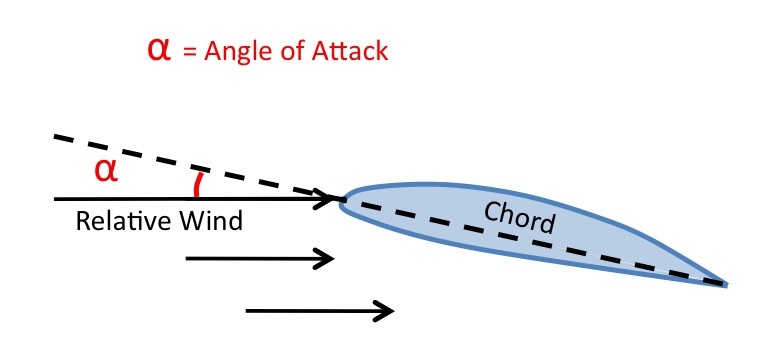
The angle of attack can be simply described as the difference between where a wing is pointing and where it is going.
Description
An increase in angle of attack results in an increase in both lift and induced drag, up to a point. Too high an angle of attack (usually around 17 degrees) and the airflow across the upper surface of the aerofoil becomes detached, resulting in a loss of lift, otherwise known as a Stall.

CopyrightSKYbrary
Note: the above diagram is sometimes referred to as the "Lift Curve"
Further Reading
FAA
- Vmc Training and Angle of Attack, FAA, General Aviation Joint Steering Committee (GAJSC) Leaflet, November 2015 (Information on engine failure procedures for multi-engine aircraft and how angle of attack (AOA) indicator systems can help prevent stall/spin accidents)
Categories
What Links Here (80)
- Camber
- Canard
- Compressor Stall
- Pitch
- Slats
- CL60, Birmingham UK, 2002
- B744, en-route, north of Anchorage AK USA, 1989
- A306, vicinity Nagoya Japan, 1994
- AT73, en-route, Roselawn IN USA, 1994
- AT45, vicinity Prague Czech Republic, 2012
- A321, en-route, near Pamplona Spain, 2014
- DH8A, vicinity Svolvær Norway, 2010
- SF34, en-route, northern North Sea UK, 2014
- SF34, en-route, near Caltrauna Argentina, 2011
- B738, vicinity Eindhoven Netherlands, 2013
- E145, en-route, near London ON Canada, 2014
- A333, Chicago O'Hare IL USA, 2013
- H25B, vicinity Akron OH USA, 2015
- CRJ2, en-route, northern Sweden, 2016
- FA50 / Vehicle, Moscow Vnukovo Russia, 2014
- A319, Montego Bay Jamaica, 2014
- B788, en-route, north of Darwin NT Australia, 2015
- PC12, vicinity Meekatharra WA Australia, 2016
- AT43, vicinity Fond-du-Lac SK Canada, 2017
- A140, vicinity Tehran Mehrabad Iran, 2014
- SF34, en-route, north of Edinburgh UK, 2017
- SW4, en-route, North Vancouver BC Canada, 2015
- L410, vicinity Lukla Nepal, 2017
- C500, vicinity Kelowna BC Canada, 2016
- B38M, en-route, northeast of Jakarta Indonesia, 2018
- B738, Rome Ciampino Italy, 2008
- B38M, en-route south east of Addis Ababa Ethiopia, 2019
- B744, en-route, southeast of Hong Kong SAR China, 2017
- A320, vicinity Perth Australia, 2015
- A332, en-route, mid Atlantic, 2013
- A320, vicinity Delhi India, 2017
- E120, Amsterdam Netherlands, 2016
- E50P, Berlin Schönefeld Germany, 2013
- AT75, vicinity Yasouj Iran, 2018
- A320, Macau SAR China, 2018 (1)
- AT75, en-route, near Almansa Spain, 2017
- A320, vicinity Karachi Pakistan, 2020
- E190, en route, Bwabwata National Park Namibia, 2013
- Aerodynamic Stall Awareness and Avoidance
- Bank Angle Awareness
- Recovery from Unusual Aircraft Attitudes
- High-Altitude Flight Operations
- Recovery from Wake Vortex Encounter
- Induced Drag
- Stall
- Dangers of Flight with Power Below Flight Idle
- Deep Stall
- Ice Contaminated Tailplane Stall
- Ice Induced Roll Upset
- Stall Warning Systems
- Stick Pusher
- Aerofoil
- Centre of Pressure
- Glide Performance
- Rudder Blanking
- Aerodynamic Effects of In-Flight Icing
- Aircraft and In Flight Icing Risks
- In-Flight Icing: Guidance for Controllers
- Maneuvering Characteristics Augmentation System (MCAS)
- Propeller
- T-tail
- JU52, en-route, west of Chur Switzerland, 2018
- AT76, en-route, near Førde Airport Norway, 2016
- NTSB Safety Recommendations Report Arising from the Boeing 737 MAX-8 Fatal Accidents in 2018 and 2019
- Autothrottle/Autothrust
- Landing Gear
- MD82, Tarbes France, 2018
- A343, Bogotá Colombia, 2017 (2)
- E550, Paris Le Bourget France, 2017
- A388, en-route, Bay of Bengal India, 2019
- DHC2, manoeuvring, Jerusalem Bay north of Sydney Australia, 2017
- B738, vicinity Paris Orly France, 2018
- CL60, Calgary Canada, 2020
- A320, vicinity Muscat Oman, 2019
- AT45, en-route, north of Aurillac France, 2018