Lift
Lift
Article Information
Category:

Content source:

Content control:

Last modified:
14.Nov.2025
Article UID:
Cite This Page
SKYbrary Aviation Safety. (November 14, 2025). Lift.
Retrieved September 2, 2026
from https://skybrary.aero/articles/lift
UID: 23222
Copied!
COPY
Description
Air flowing around the surface of a solid object applies a force on it. It doesn't matter whether the object is moving through a stationary mass of air (e.g. an aircraft flying through the air) or whether the object is stationary and the air is moving (e.g. a parked aircaft being subjected to strong winds) or whether both are moving. Lift is the component of this force that is perpendicular to the oncoming flow direction. Lift is always accompanied by a drag force, which is the component of the surface force parallel to the flow direction.
On an aircraft, the dynamic effect of the air travelling over the wing (the aerofoil) creates a force (lift) which is perpendicular to the flightpath through the wing's centre of lift. Lift opposes the downward force of weight.
Wing design applies Bernoulli's Principle to help generate lift. Bernoulli's Principle states that an increase in the speed of a fluid occurs simultaneously with a decrease in pressure. A typical aerofoil has a curved, or cambered, upper surface. This forces the air flowing over the top of the aerofoil to move faster than the air passing below it, resulting in a pressure differential that causes a lifting force.
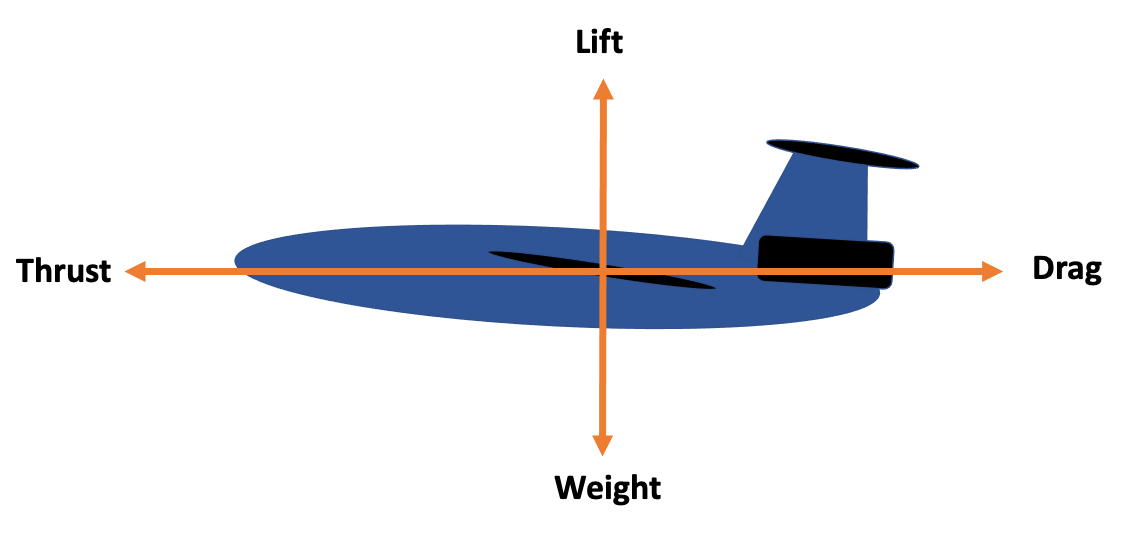
Figure 1: The relationship between Lift, Drag, Weight, and Thrust
Categories
What Links Here (50)
- Wake Vortex Turbulence
- Ailerons
- Asymmetric Flaps
- Camber
- Differential Ailerons
- Elevator
- Flaps
- High Lift Devices
- Hot Weather Operations
- Krueger Flaps
- Slats
- Thrust
- Wing Tip Drag Reduction Devices
- AT43, vicinity Fond-du-Lac SK Canada, 2017
- B752, Alicante Spain, 2017
- Tail Strike
- Wake Vortex Propagation and Decay
- En-route Wake Vortex Hazard
- Induced Drag
- Stall
- Dangers of Flight with Power Below Flight Idle
- Deep Stall
- In-Flight Icing
- Aerofoil
- Angle of Attack (AOA)
- Aquaplaning
- Bernoulli's Principle
- Centre of Pressure
- Critical Mach Number
- Drag
- Glide Performance
- Hot and High Operations
- Mach Tuck
- Parasite Drag
- Supercritical Aerofoils
- Theory of Flight
- Wing Sweep
- Aerodynamic Effects of In-Flight Icing
- Hoar Frost
- In-Flight Icing: Guidance for Controllers
- Microburst
- Spoilers And Speedbrakes
- Ground Effect
- Performance shear
- Lift/Drag Ratio, Forces Interaction and Use/Answer 1
- Lift/Drag Ratio, Forces Interaction and Use/Answer 2
- Lift/Drag Ratio, Forces Interaction and Use/Answer 3
- Aerofoil Terminology/Answer 1
- Aerofoil Terminology/Answer 2
- Wing Mechanism/Answer 2