Transponder
Transponder
Article Information
Category:

Content source:

Content control:

Last modified:
19.Jun.2022
Article UID:
Cite This Page
SKYbrary Aviation Safety. (June 19, 2022). Transponder.
Retrieved September 2, 2026
from https://skybrary.aero/articles/transponder
UID: 24135
Copied!
COPY
Description
A transponder (XPDR) is a receiver/transmitter which will generate a reply signal upon proper interrogation; the interrogation and reply being on different frequencies. (ICAO)
Transponders first came into use to enable military authorities to identify friendly aircraft, which transmitted a coded signal when interrogated by military radar. This was known as IFF (Identification Friend or Foe).
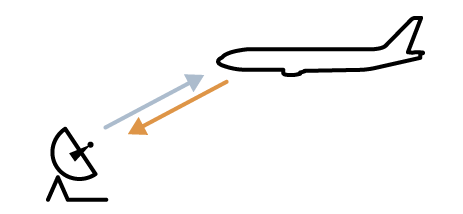
Secondary Surveillance Radar
Subsequently, transponders have come into widespread use in civil as well as military aviation. It is now standard practice to allocate a specific transponder code to each aircraft flying in controlled airspace so that the ATCO can readily identify a specific aircraft on a crowded radar screen, using SSR (Secondary Surveillance Radar).
By international agreement, 2000 is used for aircraft which have not been assigned a transponder code, although in some parts of Europe, 7000 is used for this purpose. Details of standard codes in different countries may be found in national Aeronautical Information Publications (AIPs).
Special codes are used in emergency, as follows:
- hi-jack (7500);
- loss of communication (7600); and,
- general emergency (7700).
Currently there are systems such as Airport Surface Detection Equipment–Model X (Airport Surface Detection Equipment, Model X (ASDE-X)) and Advanced Surface Movement Guidance and Control System (Advanced Surface Movement Guidance and Control System) which use transponder returns from both aircraft and of airport service vehicles with installed transponders to improve safety and efficiency the surface movement control. A number of large airports have included information in the Automatic Terminal Information Service (ATIS) broadcasts when the transponder is required to be active for taxi operations. Furthermore at certain airports, a locally-optimised mix of available technologies, i.e. airport Multilateration, Surface Movement Radars and Automatic Dependent Surveillance Broadcast (ADS-B), enables A-SMGCS systems and integrated airport operations. This could include the availability of suitable display of surveillance information on a consolidated display in the form of a moving map in flight decks and in surface vehicles.
Mode A, C, S and Ident
Civil aircraft may be equipped with transponders capable of operating in different modes:
- Mode A equipment transmits an identifying code only.
- Mode C equipment enables the ATCO to see the aircraft altitude or flight level automatically.
- Mode S equipment has altitude capability and also permits data exchange.
Mode C or S equipment is a mandatory requirement for many busy areas of controlled airspace.
Transponders have an “Ident” facility which causes the aircraft radar response to stand out when the pilot operates the Ident switch in the cockpit. This should only be operated upon ATC request.
Legal Requirements
Regulation (EU) No 1207/2011 requires that all flights operating as general air traffic in accordance with instrument flight rules within the EU are equipped with mode S transponders.
Transponder Use in ATM
Transponders are used in ATM for various purposes, the most notable of them being:
- Aircraft identification;
- Enhancing the controllers' situational awareness;
- Development of ATC tools and safety nets (e.g. AMAN, MTCD, STCA, etc.).
Transponders and ACAS
Airborne Collision Avoidance System (ACAS) operation requires that both aircraft - the interrogator and the target - are equipped with operating transponders. An aircraft equipped with ACAS will receive the following information depending on the type of transponder with which the target aircraft is equipped:
| Target aircraft equipped with: | Interrogator aircraft equipped with ACAS: |
|---|---|
| Mode 'A' transponder only | Will not track the target |
| Mode 'A/C' transponder with no altitude reporting | Below FL 155: Receives Traffic Advisory (TA) only (no altitude or trend arrow will be shown)
Above FL 155: Will not show the target |
| Mode 'C' or 'S' transponder | Receives TA and vertical Resolution Advisory (RA) |
| ACAS | Receives TA and coordinated vertical RA |
Related Articles
Categories
What Links Here (107)
- Loss of Separation
- Loss of Separation - Pilot-induced Situations
- Airspace Infringement
- Airspace Infringement and Communication
- ATC Clearance
- Due Regard
- Emergency Transponder Codes
- Height Monitoring Units (HMU)
- Mode C
- Monopulse Secondary Surveillance Radar (MSSR)
- North Atlantic Operations - Airspace
- Radar
- Radar Identification
- Squitter
- Transponder Mandatory Zone (TMZ)
- Wide Area Multilateration (WAM)
- B738 / E135, en-route, Mato Grosso Brazil, 2006
- A319, en-route, Nantes France, 2006
- ATP, en-route, Oxford UK, 1991
- B741, en-route, Gunma Japan 1985
- ULAC / A319 vicinity Southend UK, 2013
- B190 / B737, Calgary Canada, 2014
- B738 / C172, en route, near Falsterbo Sweden, 2014
- A320 / GLID, vicinity Memmingen Germany, 2015
- B738 / AS25, en-route, near Frankfurt Hahn Germany, 2013
- E170 / F900, en-route, east of Varna Bulgaria, 2015
- H25B / AS29, en-route / manoeuvring, near Smith NV USA, 2006
- F16 / C150, vicinity Berkeley County SC USA, 2015
- H25B / B738, en-route, south eastern Senegal, 2015
- UAV, manoeuvring, north of Reims France, 2006
- A332 / Vehicle, Madrid Spain, 2014
- BN2P / B763, vicinity Kagoshima Japan, 2015
- A343 / RJ1H, Copenhagen Denmark, 2016
- C130 / C27J, manoeuvring, near Mackall AAF NC USA, 2014
- A319 / AS32, vicinity Marseille France, 2016
- F2TH / GLID, vicinity St Gallen-Altenrhein Switzerland, 2017
- A310 / C421, en-route, northeast of Montréal Canada, 2018
- B772 en-route suspected location southern Indian Ocean, 2014
- Military Interception Signalling
- Read-back or Hear-back
- Airspace Infringement and Briefing
- Barometric Pressure Setting Advisory Tool (BAT)
- Correlation
- Midair Collision
- Reduced Vertical Separation Minima (RVSM)
- Strategic Lateral Offset
- Surveillance
- Visual Scanning Technique
- Airspace Infringement and Navigation
- Electrical Fires
- Controller Detection of Manoeuvring Area Conflicts
- Controller Detection of Manoeuvring Area Conflicts – Safety Barriers
- Methods to Show an Occupied Runway
- Operation of SSR Mode C by General Aviation VFR Recreational Flights
- ATC Loss of Transponder Signal
- Embraer 135, 140, 145, Legacy - Inadvertent Change of Radio Frequencies or Placing Transponder into Standby Mode
- Surveillance: anomaly on Mode-S transponders
- TCAS RAs Generated due to Transponder Testing on the Ground
- Unauthorised Penetration of Airspace
- Update on Erroneous '0607' squawk
- Engine Failure in Cruise
- In-Flight Fire: Guidance for Controllers
- Electrical Problems: Guidance for Controllers
- Altimeter Setting Procedures
- Parallel Runway Operation
- Impact of transponder failure on safety barriers
- Transponder Failure Types
- Air-Ground Communication
- Communication Failure: Guidance for Controllers
- Operation without a Transponder or with a Dysfunctional Transponder
- Aircraft Electrical Systems
- Minimum Safe Altitude Warning (MSAW)
- Taxiway Collisions
- Ditching: Fixed Wing Aircraft
- Airborne Collision Avoidance System (ACAS)
- Aircraft Without Transponder – Mitigations
- Civil-Military Interaction in ATM
- Plots, Tracks and Labels
- Primary Surveillance Radar (PSR)
- Secondary Surveillance Radar (SSR)
- TCAS RA Reversal
- Formation Flights
- Altimeter
- An aircraft without transponder – Guidance for Controllers
- Autonomous Operations Basics
- Emergency Descent: Guidance for Flight Crews
- En-route Tracking of Aircraft
- Global Aeronautical Distress and Safety System (GADSS)
- Incorrect use of TCAS Traffic Display
- Information Processing
- Landing without Clearance – Precursors and Defences
- Mode S
- Pilot Memory Aids
- TCAS II Activation
- TCAS II and VFR Traffic
- Transponder Requirements for Access to EU Airspace
- Weather Radar and ATC
- Duplicated SSR Code
- A319 / WT9, vicinity Stuttgart Germany, 2017
- A388, vicinity Moscow Domodedovo Russia, 2017
- E170 / Vehicles, Toronto Canada, 2019
- B738 / B738 / B752, Birmingham UK, 2020
- S76, en-route, northwest of Los Angeles USA, 2020
- Transponder IDENT Feature
- Identification
- B738 / Vehicle, Palma Spain, 2020
- Discrete and Non-discrete SSR Codes