Locator Outer Marker (LOM)
Locator Outer Marker (LOM)
Article Information
Category:

Content source:

Content control:

Last modified:
29.Aug.2023
Article UID:
Cite This Page
SKYbrary Aviation Safety. (August 29, 2023). Locator Outer Marker (LOM).
Retrieved September 3, 2026
from https://skybrary.aero/articles/locator-outer-marker-lom
UID: 34200
Copied!
COPY
Definition
Locator outer marker (LOM). NDB compass locator, collocated with an outer marker (OM).
Source: US FAA Pilot’s Handbook of Aeronautical Knowledge
Description
The locator outer marker (LOM) is a NAVAID that comprises:
- a locator, which is a low/medium frequency NDB uses as an aid to final approach
- a marker, which is a low-powered transmitter that directs its signal upward in a narrow pattern
The LOM is placed along the flight path of the final approach, usually about 4 NM from the runway threshold (but, depending on local terrain and other considerations this may vary between 3.5 NM and 6 NM). Both facilities have limited coverage - the locator's is usually between 10 and 25 NM and the marker's is 600 m plus or minus 200 m (2 000 ft plus or minus 650 ft).
Markers provide aural identificaiton when overflown. All markers utilize a carrier frequency of 75 MHz and the identification is frequency modilated. The outer marker identification is 2 dashes per second continuously and the tones are at 400 Hz. The locator (NDB) is identified by two or three letters.
LOMs are represented on aeronautical charts by a combined locator/marker symol. The marker is oriented perpendicularly to the flight path.
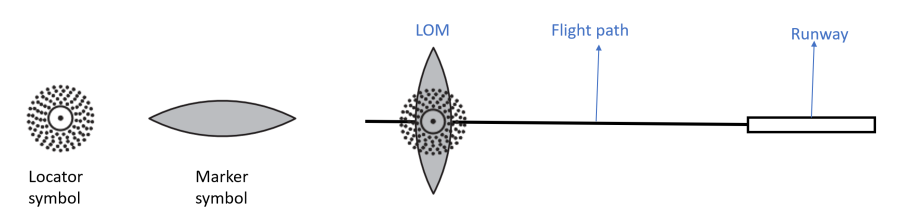
CopyrightSKYbrary
Related Articles
Categories