Team Resource Management (TRM)
Team Resource Management (TRM)
Article Information
Category:

Content source:

Content control:

Last modified:
27.Mar.2025
Article UID:
Cite This Page
SKYbrary Aviation Safety. (March 27, 2025). Team Resource Management (TRM).
Retrieved September 3, 2026
from https://skybrary.aero/articles/team-resource-management-trm
UID: 22951
Copied!
COPY
Description
Team Resource Management (TRM) is defined as: Strategies for the best use of all available resources - information, equipment and people - to optimise the safety and efficiency of Air Traffic Services.
By the early 1990s, the corresponding concept of Crew Resource Management (CRM) had been embodied in flight crew training by among aircraft operators for many years and there was already good evidence to show that those programmes had been successful in reducing accident and incident rates. TRM was identified as a way of following CRM principles and both, along with the more recent Maintenance Resource Management (MRM), have now been embraced in the wider context of safety management as interventions that defend aircraft operations against common causes of system failure.
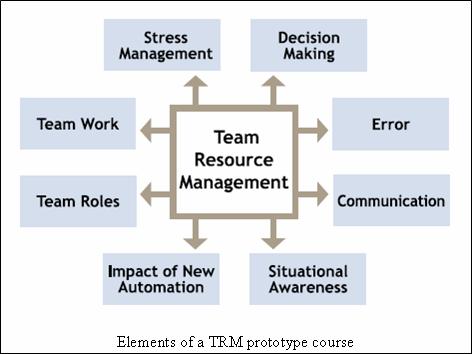
Like CRM, TRM was based on the recognition that many operational incidents could be traced back to failures in human performance and teamwork. A EUROCONTROL initiative led to the creation of one of the first TRM training programmes. This prototype included separate modules on Teamwork, Team roles, Communication, Situational Awareness, Decision Making and Stress. Later two additional modules were added to cover the management of error and violation and the impacts of automation.
Effective TRM in ATC requires the best use of all available resources in support of a safe and efficient operation which reduces both the incidence of error and the consequences of residual error. A focus on TRM is especially designed to improve the functioning of air traffic control teams. It does this by increasing the awareness and understanding of interpersonal behaviour and human factor capabilities as they are likely to affect operational safety.
There is also evidence to show that CRM principles can be successfully applied to air traffic management. TRM training can reduce teamwork-related incidents and enhanced task efficiency.
The main benefits of TRM are now considered to be:
- Reduced teamwork-related incidents
- Enhanced task efficiency
- Improved use of staff resources
- Enhanced continuity and stability of team work in ATM
- Enhanced sense of working as a part of a larger and more efficient team
- Increased job satisfaction
TRM and Safety Culture
Team Resource Management (TRM) training can be a powerful Safety Culture improvement enabler. A properly designed, implemented and sustained TRM program is an important safety initiative for any Air Navigation Services Provider (ANSP).
Further Reading
- Team Resource Management - Guidelines for the Implementation and Enhancement of TRM, EUROCONTROL, 26 April 2021.
- Annex A to TRM Guidance Material - TRM Modules, EUROCONTROL, 26 April 2021.
- Annex B to TRM Guidance Material - Facilitator Competence and Training, EUROCONTROL, 26 April 2021.
- Annex C to TRM Guidance Material - Air Traffic Control Safety Questionnaire, EUROCONTROL, 7 August 2019.
- EUROCONTROL Guidelines for TRM Good Practices, 18 March 2015
- TRM Implementation Report 2011, EUROCONTROL, 2011.
- TRM Implementation Report 2014, EUROCONTROL, March 2015.
- TRM Implementation Report 2017, EUROCONTROL, March 2018.
- EUROCONTROL TRM Booklet (1994) addressed to both operational and managerial staff.
- Guidelines for Development and Implementation of TRM (1996)
- A Report from the EUROCONTROL Team Resource Management Task Force which explains their work and provides resultant guidance on implementation based upon lessons learned (1999)
Categories
What Links Here (37)
- Level Bust
- Standard Operating Procedures (SOPs)
- Group Dynamics
- Group Interaction
- B738 / E135, en-route, Mato Grosso Brazil, 2006
- B789 / C172, en-route, northwest of Madrid Spain, 2017
- B738, en-route, east of Asahikawa Japan, 2010
- Air-Ground Voice Communications
- Blind Spots - Inefficient conflict detection with closest aircraft
- Midair Collision
- Human Factors Analysis and Classification System (HFACS)
- ICAO SHELL Model
- Critical Incident Stress Management in ATM
- Fatigue
- Perception in ATC
- Teamwork in Air Traffic Control
- Vigilance in ATM
- Interruption or Distraction
- ATCO On-Duty Fitness
- Controller Workload
- Crew Resource Management (CRM)
- Conflict Detection with Adjacent Sectors
- Ramp Resource Management
- Authority Gradients
- Improving Safety Culture in Air Traffic Control
- Recency Bias
- Stress in Air Traffic Control
- Threat and Error Management (TEM) in ATC
- Violation
- Mood
- Managing Socio-Cultural Diversity
- Development of ATCO Loyalty
- Controller Training Methods and Tools
- Interpersonal Communication in ATCO Training
- Selection Procedures for Air Traffic Controllers
- The Use of Interviews as Part of ATCO Selection Process
- ATCO Refresher Training