Rudder
Rudder
Article Information
Category:

Content source:

Content control:

Last modified:
24.Jun.2022
Article UID:
Cite This Page
SKYbrary Aviation Safety. (June 24, 2022). Rudder.
Retrieved September 2, 2026
from https://skybrary.aero/articles/rudder
UID: 1596
Copied!
COPY
Description
The rudder is a primary flight control surface which controls rotation about the vertical axis of an aircraft. This movement is referred to as "yaw". The rudder is a movable surface that is mounted on the trailing edge of the vertical stabilizer or fin. Unlike a boat, the rudder is not used to steer the aircraft; rather, it is used to overcome adverse yaw induced by turning or, in the case of a multi-engine aircraft, by engine failure and also allows the aircraft to be intentionally slipped when required.
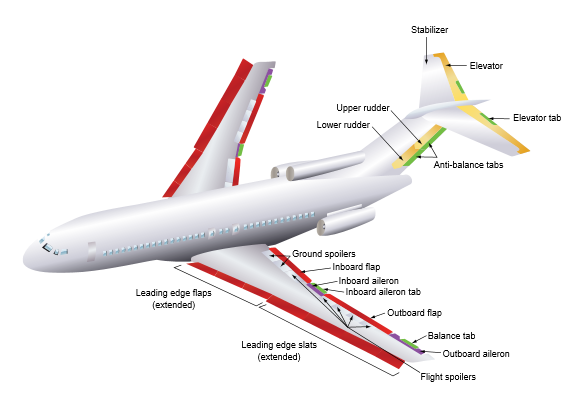
B727 Flight Control Surfaces. Source: Wikicommons. Origin: FAA(USA)
Function
In most aircraft, the rudder is controlled through the flight deck rudder pedals which are linked mechanically to the rudder. Deflection of a rudder pedal causes a corresponding rudder deflection in the same direction; that is, pushing the left rudder pedal will result in a rudder deflection to the left. This, in turn, causes the rotation about the vertical axis moving the aircraft nose to the left. In large or high speed aircraft, hydraulic actuators are often used to help overcome mechanical and aerodynamic loads on the rudder surface.
Rudder effectiveness increases with aircraft speed. Thus, at slow speed, large rudder input may be required to achieve the desired results. Smaller rudder movement is required at higher speeds and, in many more sophisticated aircraft, rudder travel is automatically limited when the aircraft is flown above Manoeuvring Speed to prevent deflection angles that could potentially result in structural damage to the aircraft.
Related Articles
Categories
What Links Here (49)
- Ailerons
- Axis of Rotation
- Coupled Ailerons and Rudder
- Differential Ailerons
- Elevator
- Flight Controls
- Gyroplane
- Manoeuvring Speed
- Spin Recovery
- Trim Systems
- Trim Tab
- V-Tail
- Minimum Control Speed (air) (Vmca)
- CL60, Birmingham UK, 2002
- B744, en-route, north of Anchorage AK USA, 1989
- A306, vicinity New York JFK, 2001
- SF34, Stornoway UK, 2015
- D328, Sumburgh Shetland Islands UK, 2017
- A140, vicinity Tehran Mehrabad Iran, 2014
- A320, Tehran Mehrabad Iran, 2016
- E145, Bristol UK, 2017
- B773, Munich Germany, 2011
- B772, Dhaka Bangladesh, 2018
- AT72, Trollhättan Sweden, 2018
- E190, manoeuvring, northeast of Lisbon Portugal 2018
- B744, Maastricht-Aachen Netherlands, 2017
- AT75, Port Vila Vanuatu, 2018
- Flight Control Protection from Damage by Strong Winds
- Rudder Blanking
- Cross Wind Takeoff Hazards and Techniques
- Takeoff Configuration Warning Systems (TOCWS)
- AT76, en-route, near Førde Airport Norway, 2016
- MD82, Tarbes France, 2018
- B773, Hong Kong China, 2017
- A320, Calicut India, 2019
- A333, Medan Indonesia, 2020
- B738, Goa India, 2016
- GLEX, Liverpool UK, 2019
- C525, vicinity Bournemouth UK, 2019
- AT45, en-route, north of Islamabad Pakistan, 2016
- AT76, vicinity Dublin Ireland, 2016
- ATP, Birmingham UK, 2020
- JS32, Münster/Osnabrück Germany, 2019
- H25B, Mykonos Greece, 2017
- Control Wheel Steering (CWS)
- GLEX, Biggin Hill UK, 2020
- A333, Port Harcourt Nigeria, 2019
- A320, Brisbane QLD Australia, 2020
- B744, Hong Kong China, 2018