Flight Controls
Flight Controls
Article Information
Category:

Content source:

Content control:

Last modified:
24.Jun.2022
Article UID:
Cite This Page
SKYbrary Aviation Safety. (June 24, 2022). Flight Controls.
Retrieved September 2, 2026
from https://skybrary.aero/articles/flight-controls
UID: 1309
Copied!
COPY
Description
Aircraft flight controls are the means by which a pilot controls the direction and attitude of an aircraft in flight.
Flight control systems are subdivided into what are referred to as primary and secondary flight controls. Primary flight controls are required to safely control an aircraft during flight and consist of ailerons, elevators (or, in some installations, stabilator) and rudder. Secondary flight controls are intended to improve the aircraft performance characteristics or to relieve excessive control loading, and consist of high lift devices such as slats and flaps as well as flight spoilers and trim systems.
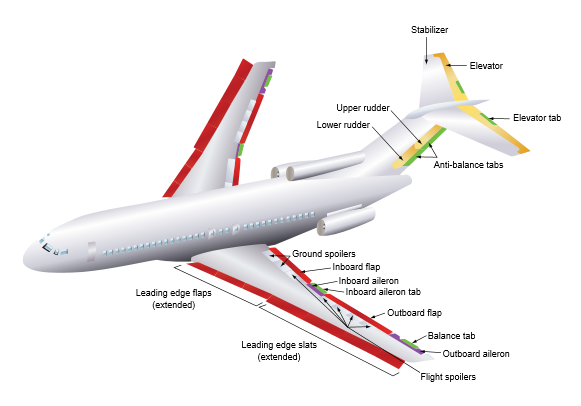
B727 Flight Control Surfaces. Source: Wikicommons. Origin: FAA(USA)
Movement of any of the primary flight controls causes the aircraft to rotate around the axis of rotation associated with the control surface. The ailerons control motion around the longitudinal axis (roll), the elevator controls rotation around the lateral axis (pitch) and the rudder controls movement around the vertical axis (yaw).
The most basic flight control systems are mechanical and, although they date back to the earliest aircraft types, are in use in the majority of light, general aviation aircraft. In this design, a collection of mechanical components such as cables, pulleys, rods and chains transmit the movement of the flight deck controls to the appropriate control surface(s). In larger and faster aircraft, the aerodynamic forces become too great for the pilot to overcome without assistance so hydraulic systems are often incorporated to move the flight control surface. In some newer aircraft models, the quest for reduced weight and the associated fuel savings has led designers to replace most of the mechanical components with computers and fiber optics to produce control systems which are referred to as Fly-By-Wire.
Related Articles
Categories
What Links Here (33)
- Ailerons
- Axis of Rotation
- Canard
- Coupled Ailerons and Rudder
- Differential Ailerons
- Elevator
- Flaperons
- Gyroplane
- Manoeuvring Speed
- Rudder
- Stabilator
- Trim Systems
- Trim Tab
- Trimmable Horizontal Stabiliser
- V-Tail
- DC10, Sioux City USA, 1989
- A306, vicinity New York JFK, 2001
- B752, vicinity Keflavik Iceland, 2013
- C30J, Jalalabad Afghanistan, 2015
- AT76, en route, west-southwest of Sydney Australia, 2014
- B738, Auckland New Zealand, 2013
- FA7X, en-route, north east of Kuala Lumpur Malaysia, 2011
- B788, en-route, north of Darwin NT Australia, 2015
- B38M, en-route, northeast of Jakarta Indonesia, 2018
- MD83, Ypsilanti MI USA, 2017
- DH8B, Nuuk Greenland, 2019
- E190, manoeuvring, northeast of Lisbon Portugal 2018
- B738, vicinity Kittilä, Finland 2012
- Engine Failure in Cruise
- Cross Wind Takeoff Hazards and Techniques
- Hydraulic Problems: Guidance for Flight Crews
- Takeoff Configuration Warning Systems (TOCWS)
- Control Wheel Steering (CWS)