Fire in the Air
Fire in the Air
Article Information
Category:

Content source:

Content control:

Last modified:
23.Jan.2026
Article UID:
Cite This Page
SKYbrary Aviation Safety. (January 23, 2026). Fire in the Air.
Retrieved September 2, 2026
from https://skybrary.aero/articles/fire-air
UID: 22753
Copied!
COPY
Definition
A fire which occurs while an aircraft is airborne.
In flight fire from SKYbrary on Vimeo.
Description
Fire in the air is one of the most hazardous situations that a flight crew can be faced with. Without aggressive intervention by the flight crew, a fire on board an aircraft can lead to the catastrophic loss of that aircraft within a very short space of time. Once a fire has become established, it is unlikely that the crew will be able to extinguish it.
Time is critical
The following table from a UK CAA report in 2002 supports the generally held view that, from the first indication that there is a fire onboard the aircraft, the crew has on average approximately 17 minutes to get the aircraft on the ground.
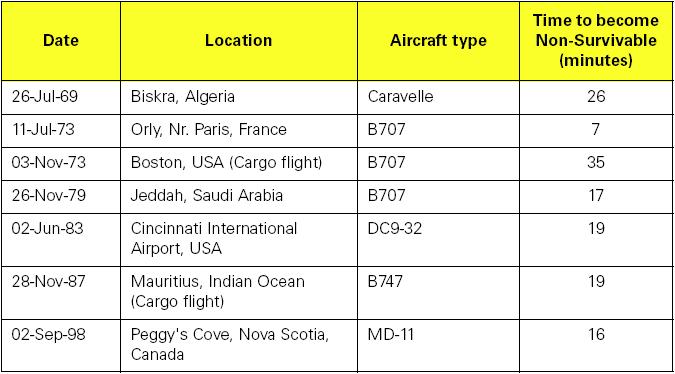
UK CAA Paper 2002/01, Hidden Fires - Time to Become Non-Survivable (page 6, see Further Reading)
Types
- Engine Fire. An engine fire is normally detected and contained satisfactorily by the aircraft fire detection and suppression systems. However, in certain circumstances (e.g. an explosive breakup of the turbine), the nature of the fire is such that onboard systems may not be able to contain the fire and it may spread to the wing and/or fuselage. Where an engine fire has been successfully contained, there is still a risk that the fire may reignite and therefore it is still advisable for the crew to land the aircraft as soon as possible and allow fire crews to carry out a visual examination of the engine.
- Cabin Fire. A fire within the cabin will usually be detected early and be contained by the crew using onboard fire fighting equipment. As with an engine fire, it is still advisable to land the aircraft as soon as possible and carry out a detailed examination of the cause of the fire and any damage.
- Hidden Fire A hidden fire may be detected by onboard fire detection systems or by the crew or passengers noticing smoke or fumes, a hot spot on a wall or floor, or by unusual electrical malfunctions particularly when the systems are unrelated. This is the most dangerous type of fire for 2 reasons:
- Hidden fires are difficult to locate and access in order to fight them. The time delay may allow the fire to take hold and do considerable damage to the aircraft.
- A hidden fire may initially be difficult to confirm and the crew may be slow to initiate an emergency landing. The consequence of such a delay may be that the fire becomes non-survivable before the aircraft has an opportunity to land.
Effects
- Smoke & Fumes. Smoke can reduce visibility within the aircraft. An electrical fire in an aircraft typically generates a lot of thick white smoke which can render the flight crew blind, unable to see the instruments or see out of the windows. In such circumstances, unless the smoke can be cleared, the crew are unable to control the aircraft. Smoke and fumes from an in-flight fire are likely to be highly toxic and irritating to the eyes and respiratory system. Smoke and fumes may therefore quickly incapacitate the crew unless they take protective action.
- Heat. Heat from fires will affect aircraft systems and ultimately affect the structural integrity of the aircraft both of which will lead to Loss of Control
Defences and Solutions
- Prevention. This includes making the aircraft as fire resistant as possible as well as installing fire detection systems.
- Fight the fire using any means available (e.g. fire suppression systems, hand-held extinguishers)
- Use protective equipment (e.g. smoke hoods and oxygen masks). to prevent crew incapacitation and injury.
- Land as soon as possible. This often includes an emergency descent and landing at the nearest suitable aerodrome. In some situations, an off-aerodrome landing or ditching should be considered.
Accidents and Incidents
On 5 June 2015, a DHC8-200 descending towards Bradley experienced an in-flight fire which originated at a windshield terminal block. Attempts to extinguish the fire were unsuccessful with the electrical power still selected to the circuit. However, the fire eventually stopped and only smoke remained. An emergency evacuation was carried out after landing. The Investigation was unable to establish the way in which the malfunction that caused the fire arose but noted the continuing occurrence of similar events on the aircraft type and five Safety Recommendations were made to Bombardier to address the continuing risk.
On 27 July 2006, a Bombardier CRJ200 being operated by Air Nostrum on a scheduled passenger flight from Barcelona to Basel, Switzerland in night VMC, suffered a sudden left hand engine failure and an associated engine fire when passing FL235 some 14 minutes after take off. An air turn back was made with indications of engine fire continuing until just three minutes before landing. An evacuation using the right hand exits was ordered by the Captain as soon as the aircraft had come to a stop and had been promptly actioned with the RFFS in attendance. There were no injuries to the 48 occupants during the evacuation and the only damage was to the affected engine.
On 3 September 2010, a UPS Boeing 747-400 freighter flight crew became aware of a main deck cargo fire 22 minutes after take off from Dubai. An emergency was declared and an air turn back commenced but a rapid build up of smoke on the flight deck made it increasingly difficult to see on the flight deck and to control the aircraft. An unsuccessful attempt to land at Dubai was followed by complete loss of flight control authority due to fire damage and terrain impact followed. The fire was attributed to auto-ignition of undeclared Dangerous Goods originally loaded in Hong Kong.
On 2 September 2006, a UK Royal Air Force (RAF) Nimrod, engaged in operations over Afghanistan experienced a fuel-fed bomb bay fire shortly after completing air-to-air refuelling. The fire spread and the aircraft exploded in flight before the crew were able to land at Kandahar. The Investigation concluded that the fuel leak had been the result of a series of systemic failures to ensure continued airworthiness of the aircraft type.
On 2 September 1998, an MD-11 aircraft belonging to Swissair, crashed into the sea off Nova Scotia following an in-flight electrical fire.
Further Reading
- Boeing article: Flight Crew Response to In-Flight Smoke, Fire, or Fumes
- Boeing article: Reducing Smoke and Burning Odor Events
- FAA Advisory Circular (AC) 120-80B “Firefighting of General and High-Energy In-Flight Fires”, March 16, 2023.
- Airbus FOBN Cabin Operations - Managing In-flight Fires
- ATSB Report: Evacuation Commands for Optimal Passenger Management
- UK CAA Paper 2002/01 A Benefit Analysis for Enhanced Protection from Fires in Hidden Areas on Transport Aircraft
- see also FAA "Lessons Learned from Transport Airplane Accidents": Uncontrolled Fire
RAeS and Air Pilots
- Smoke, fire and fumes in transport aircraft, past history, current risks and recommended mitigations - Part 1:References, Fifth Ed., 2018, Royal Aeronautical Society.
- Smoke, fire and fumes in transport aircraft, past history, current risks and recommended mitigations - Part 2:Training, Second Ed., 2018, Royal Aeronautical Society.
FAA Research Reports
Categories
What Links Here (92)
- Operational Fires
- Emergency or Abnormal Situation
- Hindsight 15
- MD11, en-route, Atlantic Ocean near Halifax Canada, 1998
- DC93, en-route, Cincinnati OH USA, 1983
- DC87, Philadelphia USA, 2006
- CONC, vicinity Paris Charles de Gaulle France, 2000
- B763, Manchester UK, 1998
- DC10, Newburgh NY USA, 1996
- DC93, en-route, north west of Miami USA, 1996
- SW4, Mirabel Montreal Canada, 1998
- S61, vicinity Bournemouth UK, 2002
- AS55, vicinity Fairview Alberta Canada, 1999
- NIM, manoeuvring, northern North Sea UK, 1995
- L101, vicinity Riyadh Saudi Arabia, 1980
- NIM, vicinity Kandahar Afghanistan, 2006
- B763, Frankfurt Germany, 2007
- B738 / E135, en-route, Mato Grosso Brazil, 2006
- B752, en-route, North Sea, 2006
- AT43, vicinity Geneva Switzerland, 2006
- B734, vicinity East Midlands UK, 1989
- B738, en-route, Colorado Springs CO USA, 2006
- B744, vicinity Dubai UAE, 2010
- CRJ2, en-route, east of Barcelona Spain, 2006
- CVLP, vicinity San Juan Puerto Rico, 2012
- DC3, vicinity Yellowknife Canada, 2013
- B772, Las Vegas NV USA, 2015
- L35 / EUFI, manoeuvring, Olsberg-Elpe, Germany 2014
- MA60, en route, west of Bima Indonesia, 2011
- A388, en-route, northern Afghanistan, 2014
- DH8B, en route, southwest of Windsor Locks CT USA, 2015
- IL76, vicinity Karachi Pakistan, 2010
- E190, en-route, southwest Vermont USA, 2016
- B737, en-route, northwest of Philadelphia PA USA, 2018
- A333, en-route, southern Myanmar, 2013
- A333, vicinity Gold Coast Queensland Australia, 2017
- B752, vicinity New York JFK USA, 2016
- E190, en-route, southwest of Turku Finland, 2017
- AT72, vicinity Budapest Hungary, 2016
- AT45, vicinity Esbjerg Denmark, 2016
- A320, vicinity Tallinn Estonia, 2018
- A320, Macau SAR China, 2018 (1)
- B744, en-route, East China Sea, 2011
- B788, Boston MA USA, 2013
- A319, London Heathrow UK, 2013
- A388, en-route, north east of Singapore, 2011
- A333, en-route, near Bournemouth UK, 2012
- B788, London Heathrow UK, 2013
- Fire Smoke and Fumes
- Loss of Control
- Electrical Fires
- Wing Fire
- Brake and Undercarriage Fires
- Fire Triangle
- Hydraulic Fluid as a Fire Source
- In-Flight Fire: Guidance for Controllers
- In-Flight Fire: Guidance for Flight Crews
- Electrical Problems: Guidance for Controllers
- Emergency Communications
- Emergency Evacuation on Land
- Smoke
- Engine Fire Protection
- Halon Fire Extinguishers
- Pilot Incapacitation
- Aircraft Electrical Systems
- Uncontained Engine Failure
- Mountainous Terrain Escape Routes
- Aircraft Fire Detection Systems
- Aircraft Fire Extinguishing Systems
- Fire Extinguishing Agents
- Fumes Detection
- Smoke Hoods
- Checklists and Procedures for Non-Alerted Fire/Smoke/Fume Events
- Engine/APU on Fire: Guidance for Controllers
- Lithium-Ion Aircraft Batteries as a Smoke/Fire Risk
- Passenger Cabin Fire
- Flashover
- Aircraft Batteries
- Emergency Descent: Guidance for Controllers
- Emergency Descent: Guidance for Flight Crews
- Passenger Medical Emergencies: Guidance for Controllers
- Reportable Incidents
- Risk Assessment During Onboard Fire and Smoke (OGHFA SE)
- Unidentified Fire On Board (OGHFA SE)
- SE127: Cargo - Fire Containment
- SE223: Cargo - Hazardous Material Fires - Prevention and Mitigation
- SE224: Cargo - Hazardous Material Fires - Enhanced Fire Detection Systems (R-D)
- SE225: Cargo - Hazardous Material Fires - Containment and Suppression (R-D)
- SE226 Hazardous Materials Fires - Enhanced Protection of Occupants and Aircraft
- A321, vicinity London Gatwick, UK 2020
- DH8D, en-route, east northeast of Accra Ghana, 2018
- B772, vicinity Denver, USA, 2021