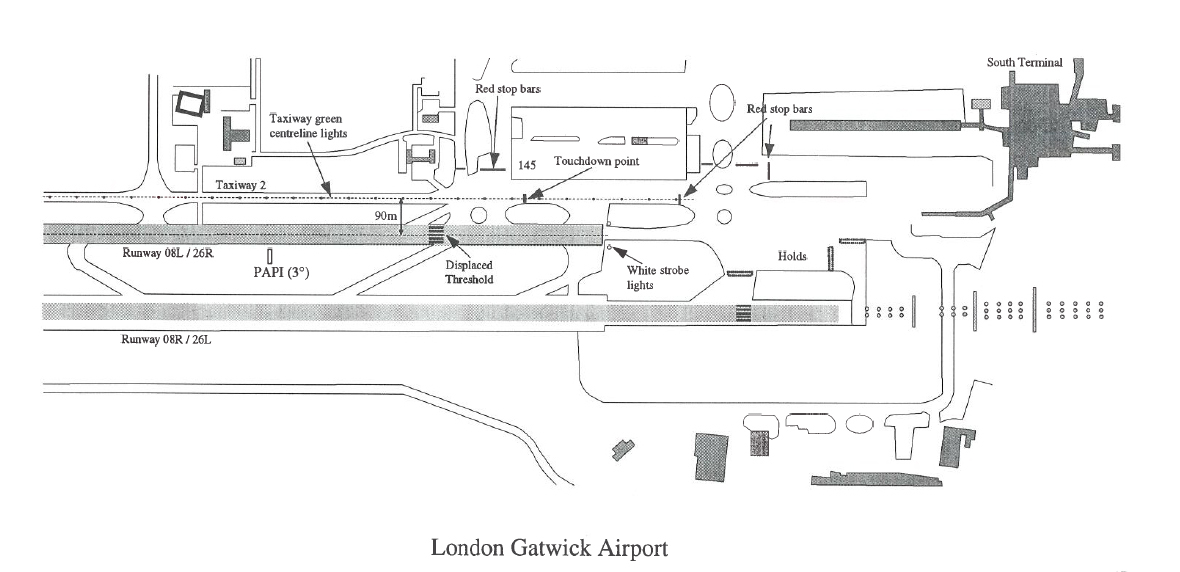



On 20 October 1993, a Boeing 737-200 being operated by Air Malta on a scheduled passenger flight from Malta to London Gatwick landed at destination on the taxiway parallel to the runway for which landing clearance had been given in good visibility at night after a Surveillance Radar Approach (SRA) terminating at 2 miles from touchdown had been conducted in VMC. There was no damage to the aircraft or injury to the occupants and the aircraft taxied to the allocated gate after the landing.
Description
On 20 October 1993, a Boeing 737-200 being operated by Air Malta on a scheduled passenger flight from Malta to London Gatwick landed at destination on the taxiway parallel to the runway for which landing clearance had been given in good visibility at night after a Surveillance Radar Approach (SRA) terminating at 2 miles from touchdown had been conducted in Visual Meteorological Conditions (VMC). There was no damage to the aircraft or injury to the occupants and the aircraft taxied to the allocated gate after the landing.
EGKK Airport Diagram
Investigation
An Investigation was carried out by the UK AAIB. It was established that the First Officer was PF for the approach to destination and that whilst both flight crew had operated to Gatwick at night before on a number of occasions, they had not landed on Runway 26R/08L before. It was noted that as the two parallel runways at Gatwick are only 200 metres apart, they cannot be used simultaneously and that Runway 26R/08L, which usually functions as one of two parallel taxiways to the north of the main runway 26L/08R and is only used as a runway to facilitate maintenance occupation of the main runway in quiet periods, usually at night.
The full content of this page is available to registered users only. Please Log in or Register