


On 2 August 2005, an Airbus A340-300 attempted a daylight landing at Toronto on a rain-soaked runway during an active thunderstorm and overran for 300 metres ending up in a ravine from where, despite its destruction by an intense post crash fire, all 309 occupants escaped. The Investigation recommendations focused mainly on improving crew decision making in adverse weather conditions and issues related to the consequences of such an overrun on survivability, the latter including one for a 300 metre RESA requirement to be implemented.
Description
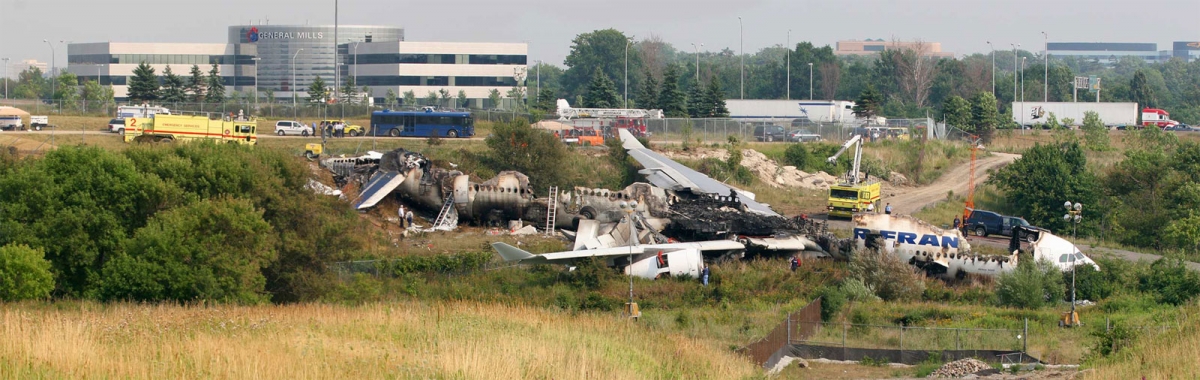
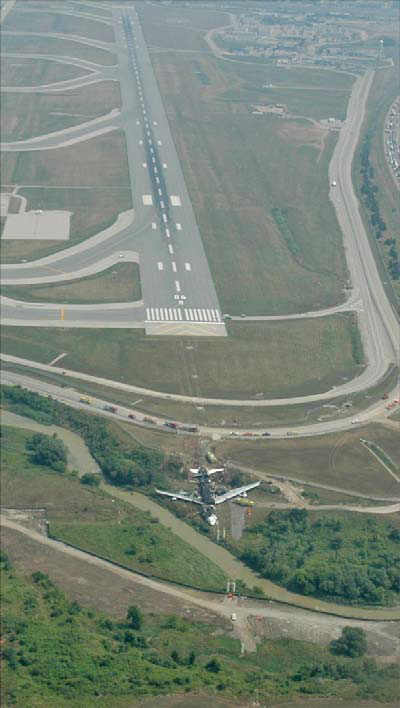
On 2 August 2005, an Airbus A340-300 being operated by Air France on a scheduled passenger flight from Paris CDG to Toronto landed at destination in daylight during a thunderstorm and failed to stop before reaching the end of the runway. It exited the airport perimeter and crossed a main road before ending up in a ravine approximately 300 m beyond the end of the runway. Although an intense post-crash fire began immediately and smoke began to enter the cabin, all 309 occupants were able to evacuate before the fire took significant hold. The fire eventually consumed most of the upper fuselage, the adjacent wing sections and the vertical stabilizer.
Air France Airbus A340-300, flight number 358, one day after the crash
A340-300 accident at CYYZ, 2005. The picture of the accident site in relation to the runway is taken from the official TSB report of the investigation which followed.
Investigation
An Investigation into the Accident was carried out by the Canadian Transportation Safety Board (TSB). It was established that all aircraft systems had been serviceable and working as designed throughout the approach and landing and that, therefore, no mechanical malfunction contributed to the accident outcome.
The full content of this page is available to registered users only. Please Log in or Register