Bishop's Ring
Bishop's Ring
Article Information
Category:

Content source:

Content control:

Last modified:
19.Jun.2022
Article UID:
Cite This Page
SKYbrary Aviation Safety. (June 19, 2022). Bishop's Ring.
Retrieved September 2, 2026
from https://skybrary.aero/articles/bishops-ring
UID: 30951
Copied!
COPY
Definition
A whitish ring, centred on the Sun or Moon, with a slightly bluish tinge on the inside and reddish brown on the outside.
- World Meteorological Organization (WMO-No. 49, Annex I)
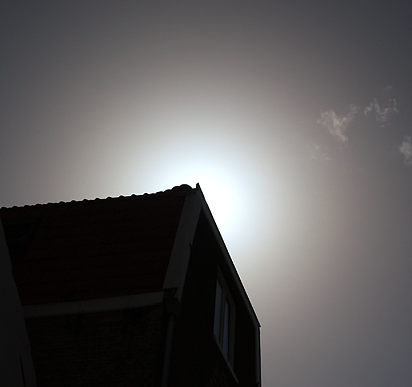
Bishop's Ring around the sun due to volcanic ash of the Eyjafjallajökull volcano on Iceland. Photographed from Leiden, the Netherlands, by Marco Langbroek on 18 May 2010. Source: Wikicommons
Description
Bishop's rings are a form of corona or illuminated ring produced by the diffraction of light passing through a cloud of very fine volcanic dust, or sulphate droplets from volcanic eruptions, in the high atmosphere. They are unlike other coronas or haloes which are produced by water droplets or ice crystals. The colours of a Bishop's ring are not very distinct. They are particularly faint in rings observed around the Moon, which usually show only a pale red fringe.
On average, the angular radius of the ring is about 28°, but it can vary between 10° and 30°, depending on the dust particle size. They are larger than other coronas but smaller than haloes. The maximum of 30° is a rather big angular radius which can only be caused by very small dust particles (0.002 mm) which all have to be of about the same size.
The Bishop's ring is named after the Reverend S. Bishop, who first described the phenomenon after the eruption of Krakatoa volcano in 1883.
Related Articles
Categories