


B733, vicinity Sharm El-Sheikh Egypt, 2004

B733, vicinity Sharm El-Sheikh Egypt, 2004

Summary

On 3 January 3 2004, a Boeing 737-300 being operated by Flash Airlines on a passenger charter flight from Sharm el-Sheikh Egypt to Cairo for a refuelling stop en route to Paris CDG crashed into the sea 2½ minutes after a night take off into VMC and was destroyed and all 148 occupants killed. The Investigation was unable to establish a Probable Cause but found evidence of AP status confusion and the possibility of distraction leading to insufficient attention being paid to flight path control.

Description

On 3 January 2004, a Boeing 737-300 being operated by Flash Airlines on a passenger charter flight from Sharm el-Sheikh Egypt to Cairo for a refuelling stop en route to Paris CDG crashed into the sea 2½ minutes after a night take off into VMC and was destroyed and all 148 occupants killed.

Investigation

An Investigation was carried out by the Egyptian Ministry of Civil Aviation (MCA). FDR and CVR data was successfully downloaded from the recovered recorders. It was noted that the prevailing weather conditions were benign and that both pilots were operating their first jet transport type, the Captain having accumulated less than 500 hours on type and the First Officer less than 250 hours on type. The Captain had previously had a long military flying career, acquiring most of his flying hours on the C130. The First Officer was in his first post as an airline pilot.

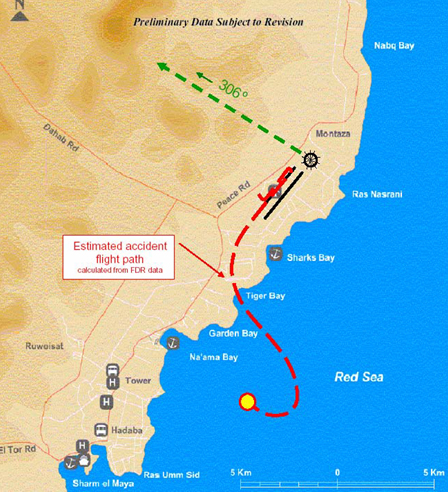
After departure from runway 22R, the aircraft was found to have been cleared for a climbing left turn to intercept the 306° radial from the Sharm el-Sheikh VOR to which allows departing flights to gain sufficient altitude before proceeding over higher terrain located along the flight path to Cairo. As shown in the diagram below, this left turn was achieved, but as the aircraft passed 5000 feet, a progressive right bank developed which was not corrected until after a steep descent at increasing airspeed had begun by which time it had exceeded 110°. Almost all the flight was conducted without the AP engaged and it was not clear whether both pilot had the same awareness of AP status during the flight. A very late attempt at recovery was evident but by then a high speed impact was inevitable.

The full content of this page is available to registered users only.
Please Log in or Register

SKYbrary Partners:

Safety knowledge contributed by: